
At Safe & Sound, we believe every family has strengths—and with the right support, those strengths can grow into deep, lasting resilience.
As part of our strengths-based, public health approach, we have integrated the Center for the Study of Social Policy’s Protective Factors Framework into our core practice model. Importantly, the Protective Factors are not just tools for working with individual families—they also reflect the conditions communities and systems must create to ensure all families can thrive.
Over the past several years, emerging research has reinforced what we at Safe & Sound have long recognized: that child and family well-being is shaped by a dynamic, interconnected set of forces that extend far beyond the home. Stanford’s New Ecology of Early Childhood (2025) calls attention to how today’s families are navigating a dramatically evolving landscape—one marked by rising economic inequality, climate change, technology-driven isolation, and intensified systemic racism and social inequities. This research underscores the importance of holistic, community-based prevention strategies—strategies that Safe & Sound has embedded within our own Ecological Framework of Prevention.
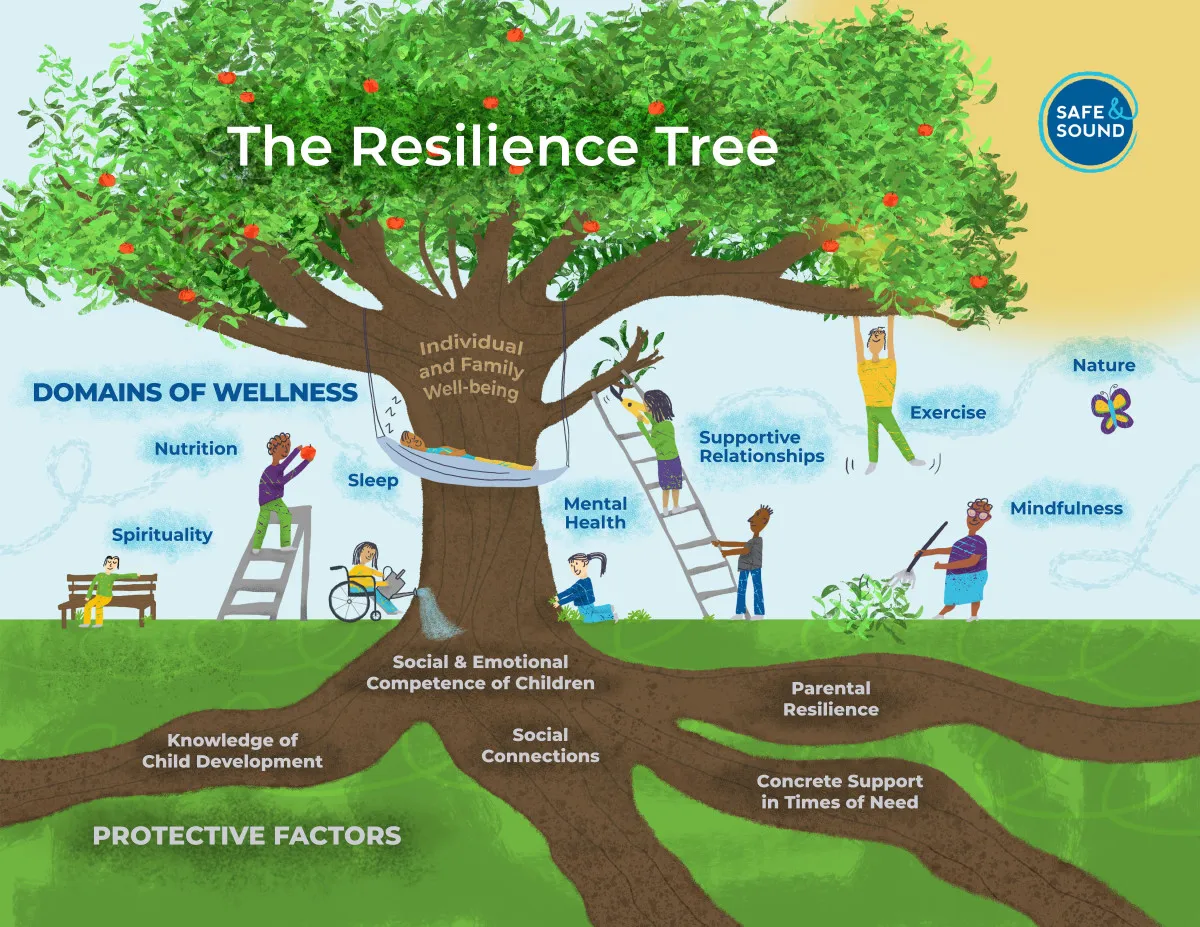
To bring this framework to life, we developed the Resilience Tree—a visual representation of how the Five Protective Factors and the Domains of Wellness work together to support individual and family well-being. Just like a tree needs strong roots and nurturing conditions to flourish, families need stability, connection, knowledge, and support to thrive.
Protective Factors: Interrelated attributes or conditions in families and communities that simultaneously (a) prevent or mitigate the effect of exposure to risk factors and stressful life events, and (b) build family strengths and a family environment that promotes optimal child development.
Domains of Wellness: This is an evidenced-based set of skills cocreated by the Center for Youth Wellness that actively build resilience and buffer the effects of toxic stress. These skills include: proper nutrition, good sleep hygiene, exercise, mindfulness, spending time in nature, attuning to one’s mental health, and having supportive relationships.
The Resilience Tree is both a symbol and a tool: a guide for how we build resilience from the ground up, while also reminding us that lasting impact requires strong, supportive environments rooted in equity, access, and care. Through this model, we connect our direct service work to broader systems change—because prevention begins not just with families, but with the world around them.
Our guiding principles reflect the core truths that guide how we understand the challenges facing children and families—and how meaningful, lasting change happens. Grounded in research, lived experience, and decades of practice, these beliefs shape our strategies, inform our theory of action, and serve as the foundation for how we design and deliver our work. They are the lens through which we see the world and the reason we pursue this mission with urgency and care.